5 Star: Christopher S. "Awesome experience! Hands down the best SEO provider in Phoenix." https://t.co/iSPt8rkYqq
— Rising Phoenix SEO (@RisingPhxSEO) November 7, 2018
from Twitter https://twitter.com/RisingPhxSEO
5 Star: Christopher S. "Awesome experience! Hands down the best SEO provider in Phoenix." https://t.co/iSPt8rkYqq
— Rising Phoenix SEO (@RisingPhxSEO) November 7, 2018
So you have built a brand, large enough for it to be searched on Google? Now, how well are you ranking for all those branded queries?
A few days ago Joy Hawkins posted a very insightful thread distinguishing between two important brand-driven search queries:
For example, [State Farm] search triggers local-three-pack results. That’s a branded search:
[State Farm Shannon Barr] returns a knowledge graph: That is a direct search:
This classification makes your local search optimization strategy much more clearer and better organized:
Let’s discuss the above two points in more detail:
Here’s one important thing that you need to always keep in mind when creating your strategy for these: More often than not, this search is driven by ROPO / ROBO (research online purchase/buy offline/online) behavior.
What this means is that those searchers already know you and are ready to purchase. In fact they are so ready that they take time researching you online.
This is huge.
This also needs to push you to keep a closer eye on those direct search results and what first impression they make when someone looks at them for the first time.
The first impression matters here. A lot.
With that in mind, perform and repeat the following exercises on a regular basis:
The search results are always evolving, so it’s important to perform those exercises on a regular basis as well come up with and implement a new plan at least yearly.
This is one of those steps that’s unbelievably missed by many, even big, brands.
Remember: Your important branded search is not just your actual business name. There are hundreds and (for bigger brands) even thousands of ways your potential customers are searching for you online.
Here are a few most important ones to keep an eye on:
And here’s another thing to remember: You want to rank #1 (and if possible #1, 2 and 3) for all of those! Otherwise, you may lose a customer to a competitor or a blogger who is suggesting a better alternative or simply advises against your brand.
But not just that! Think about all those “blended” search results that may distract the user’s attention from your brand:
Whenever these are triggered for your branded search, include a separate strategy for conquering those too, e.g. “[brand name vs your competitor’s name] needs a video”.
Serpstat is a solid platform helping you research and organize all those branded queries in a meaningful way.
Serpstat’s output gives a very good insight into search results for each keyword without the need to actually search for each one in Google. This allows you to efficiently create a thorough branded search optimization strategy.
You can read more about there keyword selection tool here.
Local-three pack has changed local search optimization a lot. It is also leaving a lot of local businesses and marketers confused because there’s not much obvious logic behind it, in some cases.
There are no official recommendations helping us understand what can get a businesses into the well-used local three pack, obviously, but here’s what I was able to collect from reputable sources and my own observations:
More on ranking in local-three pack: How to Start Ranking in Google 3 Pack ASAP
Are you optimizing for your direct and branded search queries? Let us know in the comments!
5 Star: Christopher S. "Awesome experience! Hands down the best SEO provider in Phoenix." https://t.co/iSPt8rkYqq
— Rising Phoenix SEO (@RisingPhxSEO) November 6, 2018
Sears, which long ago pioneered an early form of ecommerce through its catalog business, didn’t foresee a shifting landscape that started 25 years ago in Jeff Bezos’ garage in Seattle.
While the U.S. retail giant could have carved out a strong presence in ecommerce, it failed to act back in 2005 when Amazon became the leading internet retailer. Instead, it launched its own big-box retail chains to try to turn tide on market share loss from Walmart, Target and others.
Eleven years later in 2016, former CEO Eddie Lambert who stepped down after Sears filed for bankruptcy last month, warned of disruption to retailers like “Walmart, Nordstrom, Macy’s, Staples, Whole Foods and many others have felt the impact of disruptive changes from online competition and new business models.” Like many other retailers struggling to survive like Toys “R” Us, JCPenney and Macy’s, Sears is closing 142 unprofitable stores by the end of this year.
To better understand Sears’ under-performance in the rising ecommerce economy, we analyzed data from Jumpshot’s panel of 100 million devices that tracks more than five billion consumer actions per day. The data ranges from January 2017 to September 2018.
One key finding is that Sears has barely grown online transaction volume for nearly two years. Through September, it posted almost exactly the same number of purchases, growing just 0.03% year over year. Traffic to the site has been declining. It’s down 16% for the year.
While that means Sears is converting at a slightly higher rate with less traffic, the bad news is almost half of search engine traffic now comes from paid search ads. That’s up from just over 20% from the same time last year. Nearly half of its traffic comes from Google promotions.

The value for Sears’ historically strong brands like Craftsman, DieHard, and Kenmore has lost its luster. The retailer manufactured or sourced high-quality products to earn lasting trust that spanned generations and used them to generate loyalty. But, Sears failed to realize it could not rely on brand affinity forever, especially since brand loyalty is prevalent mostly among older generations who are the majority of Sears’ customer base. Instead, it’s limped along using the goodwill it’s generated to maintain sales or sell off its brands as assets.
In comparison, Amazon’s winning private-label strategy has focused on acquiring retail dominance and then moving in on established brands with its own often cheaper and lower-quality products to squeeze out the competition.
Jumpshot data shows that Sears’ strongest categories online are tools, appliance and shoes. Combined, they account for about half the transactions on Sears.com.
The tools category is a bright spot for Sears. It grew 50% year-over-year growth last year and Sears.com is the fourth ranking domain in category behind Amazon, Walmart and Home Depot.
But, 84% of tools purchases on Sears.com are driven by one brand, Craftsman, which represents about one-fifth of all online sales for Sears.

Though they’ve sold the brand to Stanley Black & Decker, Sears has wisely retained licensing rights for its most valuable brand for another 14 years.
Unfortunately, Sears performance for online sales in its two other top categories, appliance and shoes, is underwhelming compared to competitors.
Its Kenmore brand drives 62% of all appliance sales on Sears.com, but appliance sales have been flat so far this year, down 0.1% year-over-year through the end of Q3. It ranks ninth in market share with only a 1.6% sliver of the pie by domain. Amazon outpaces the pack with a 69% market share in the category. Others ahead of Sears in online appliance sales include Walmart, Home Depot, Lowes, Kohls, Best Buy and Bed Bath & Beyond.

Sears’ performance in the shoes category is far worse, and most of the traffic it is generating is tied to legacy brand DieHard boots.
Four of the top six keywords leading to interactions with the brand include the DieHard name, and it’s paying for consumers’ attention with nearly half of its traffic from those keywords being driven by paid ads. Overall, Sears.com is ranked 17th among a crowd of competitors for market share by domain.

In a plea to employees last month during a town hall meeting as Sears gears up for a do-or-die holiday season, Chairman Eddie Lampert said “we need to show material progress over the next few months” to avoid liquidation. In a past warning, he stated that Google and Amazon are forcing traditional brick-and-mortar businesses “to evolve or face dissatisfied users and shareholders, leading to major corporate actions.”
Even if Sears didn’t surpass Amazon as the king of ecommerce, if it had acted earlier to adapt to a changing landscape, it could have been a fierce contender. If only Sears had seen the future of online commerce around the time of its Kmart merger in 2004, it could have successfully reinvented itself as a leader in a new internet retail economy. Instead it chose to imitate other big-box retailers instead of using its considerable resources to take on Amazon.
As Kurt Vonnegut wrote: “Of all the words of mice and men, the saddest are: ‘It might have been.’” Only time will tell with Sears’ final fate, but the future is not looking bright. If you follow the search engine data insights, they clearly show the strong likelihood of Sears’ downfall in light of the rise of ecommerce.
Deren Baker is the CEO of Jumpshot.
Whether your business is in the B2B space or consumer goods, the holiday season presents some unique SEO opportunities to capitalize on, and important pitfalls to avoid.
Ecommerce, brick and mortar retail stores, and even B2B businesses can experience unique opportunities by being visible in search at a time when people are actively shopping, researching, and getting caught up on work. The holidays are a time when there is a huge uptick in SEO activity, including purchasing through ecommerce and in-person at retail stores.
Much has changed in the SEO space over the past years, but the message from search engines like Google has not changed all that much. The name of the game is still to create better content and a better experience on your website for users, based on specific user search intent.
When forming your SEO strategy for the holidays you need to identify the problems your customers will be looking to solve, and how you can present the best solution. Here are the steps you should take in forming your SEO content strategy for the holidays.
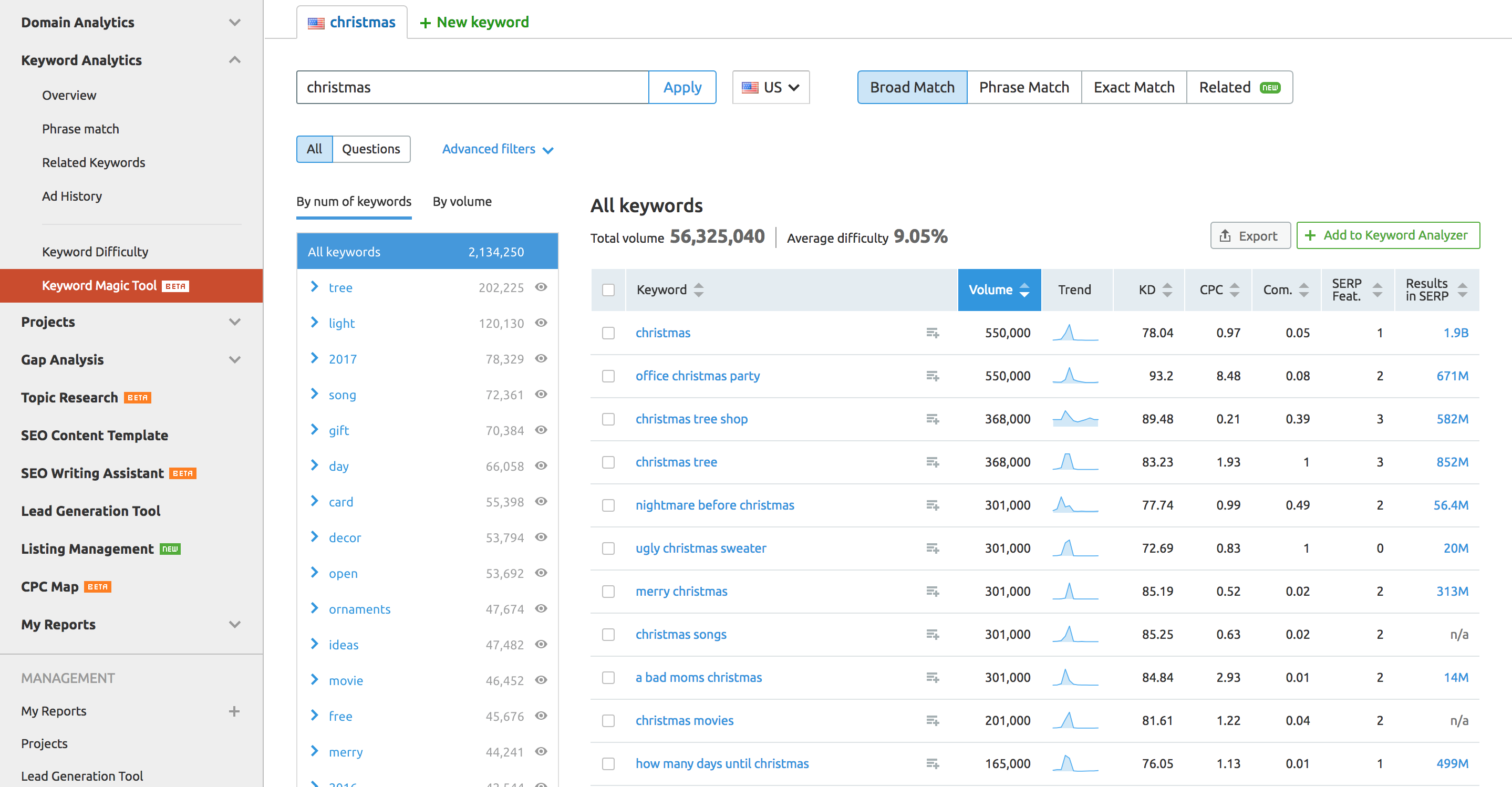
Perform an exhaustive analysis of the keywords being used by your customers when they are searching for your products or services. Consider the specific issues your customers might have during the holidays related to your business. Visit competitor sites to identify the keywords they are targeting; Screaming Frog is a great tool to crawl a website and pull meta-data for all accessible pages. Use SEMrush to see current ranking terms for your website as well as competitors.

You can use a variety of SEO tools to perform keyword research including: Google Keyword Planner, SEMrush, Moz, Wordstream, and a variety of others. Identify all variations and organize into broad groups. Once you have created broad keyword groups (and even during research), it’s a good idea to check intent by examining search results for your chosen terms. Make sure the results line up with the subject matter and type of content that makes sense for your business.
Once you have identified the keywords you are looking to rank for, take the time to examine the web pages that are dominating the search results. What about them is done well, where are they falling short? What types and depths of content are being showcased? Is it short informational videos explaining how to diagnose a home-improvement problem (like a broken garbage disposal at a holiday party), an extensive written blog post on fixing the issue, or is it a directory filled with local repair specialists?
You will want to fit in with what is already there as much as possible. You might write the one blog post that outranks all the ecommerce product pages, but this is less likely. The goal is to understand the intent of your audience and present the best solution possible. Google search results pages are your best resource here, the SERPs offer powerful data and insights into the intent and search behavior of your audience.
If you have completed thorough keyword and competitor research, you should have some ideas on the types of content you want to create in order to outperform the competition. Focus on providing better information, easier and more straightforward solutions, and plenty of details so the user gets everything they need without leaving the page.

Organize content so it is easy to digest visually; use bullet points, simple charts, images, and videos. Keep text short enough to scan, with plenty of headings and sub sections so users can easily find the information they want. Lastly, research questions that your audience is asking related to the keywords you are targeting. Including questions with thorough and accurate explanations within your content is a good way to target voice search and rich snippets.
If you sell products online through ecommerce, the holidays should already be on your radar and you likely have already been forming a strategy to maximize sales. SEO is still one of the biggest drivers of traffic and online sales across the board, so a well-crafted SEO strategy should be central to your overall digital strategy.
The rules for SEO don’t change with the season, so the same rules you follow the rest of the year still apply. The big difference is the stakes, and during the holidays the stakes are very high for many ecommerce stores. There are some things you can do to research seasonal SEO trends in order to create a strategy that capitalizes on the very best opportunities. If you can get access to monthly search volume for your target keywords (instead of just monthly average searches) you can plan ahead and target terms that you know are big during the holidays. Google Trends is also a great resource for identifying these kinds of seasonal SEO fluctuations across various keywords and topics.
While many brick & mortar retail businesses may not think about digital presence and SEO during the holidays, this is a major mistake to avoid. Lots of businesses don’t sell online and still depend on SEO visibility to drive foot traffic and in-person sales. If you are a business that gets lots of foot traffic during the holidays, you will want to make sure your local SEO listings are accurate, visible, and provide all credibility factors possible so that you’re the destination of choice for holiday shoppers who need what you’re selling.
Make sure you have claimed your Google My Business page, that it is filled out as much as possible and has updated information and pictures. Make sure your important product/service categories are listed wherever possible, and there is a link to your website (if you have one). Lastly, make sure your name, address, phone number, and hours are accurate! If you stay open later during the holidays, you better make sure your listing doesn’t say you’re closed. You can use free audits from tools like Yext & Moz Local to check your local listings and get a list of other local directory sites you will want to claim and update your business listings on (most can be done for free with a little extra research). Although, be aware you may receive a sales call after using Yext as your info may be passed to their sales team. Both are solid services for managing local listings, and for the price Bright Local is another great option.
B2B businesses are the last type you might expect to have big SEO opportunities during the holidays, but you would be wrong! Although many B2B businesses are pretty dead during the holidays, the key stakeholders, c-suite executives, and other senior management personnel are often using this time to catch up on work initiatives and other high priority tasks they couldn’t fit in before the break.
Businesses opportunities from SEO can definitely materialize around the holidays. While search volume goes down for many B2B business topics, there are also amazing opportunities that can pop up from people filling out online forms or leaving messages during the holiday break. If you can get ahead with your SEO plan and be visible in the right spots when this time hits, you might find that your competition is out to lunch when the big opportunity you have been waiting for arrives as a result of your SEO strategy.
Another big consideration around the holidays is how businesses can lower their tax liability, SEO is a great investment around this time. The truth is that if you are waiting till the holidays to develop your SEO strategy, you’re unlikely to be successful. The good news is you have a huge opportunity to get ahead for next year!
Many businesses put off SEO investment until the new year because of annual budgets and the previous year’s planning. End of the year is a great time to get ahead and gives you an advantage over competitors who kickstart new SEO programs after the new year (of which there are always a ton). There is a great deal of SEO work that requires heavy research and planning in the initial phases and making these big investments at the end of the year can get you a few months ahead of the competition.
The holidays are a great time to take advantage of increased activity and purchase behavior, but it’s critical that you plan ahead and cover your bases. If you dedicate the proper time and resources into developing a well-crafted SEO strategy, you can capitalize on some significant opportunities during the holidays and reap huge rewards.
Chris Rodgers is CEO of Colorado SEO Pros.
As I write this (1st November) thousands of Google staff in offices around the world have taken to the streets ‘to protest sexual harassment, misconduct, lack of transparency, and a workplace that doesn’t work for everyone,’ according to the movement’s official Twitter feed.
The mass walkout is just the latest public display of employee anger within the search engine. It follows criticism of the company’s involvement with Project Maven back in March, high profile resignations over the leaked Dragonfly project in August, as well as the “Rubingate” scandal uncovered by the New York Times last month which saw key Android developer Andy Rubin given ‘a hero’s farewell’ and a $90m exit package after claims of sexual misconduct were made against him.
It would appear that the treatment of Andy Rubin (amid accusations that Google admitted to be completely credible) has been the key contributing factor to the well-orchestrated global protest.
Employees are united under a banner of five clear demands they want to see implemented within the organisation. Let’s unpick these proposed changes one-by-one to get a better understanding of how a multinational company might go about making them and why they are so important for the future of the tech industry.
Forced arbitration refers to the policy of companies who only allow their employees the right to solve disputes via processes of internal arbitration.
Many organisations have forced arbitration clauses written into the employment contracts for their staff and while it isn’t a bad route to go down when employees have the option to solve disputes this way (this is known as voluntary arbitration), forced arbitration means that anyone at the company who wants to bring forward a case does not have the right to sue, to make a class action lawsuit, or to appeal – and nor do they have access to federal protections such as The Equal Pay Act of 1963.
A change within Google which would end forced arbitration in cases of harassment and discrimination would signal a fundamental shift in corporate culture which has, to date, more often sought to protect the wellbeing of the company above the wellbeing of those who work on the office floor. It would ensure that any employee who is embarking on the complex and, often, emotionally difficult process of raising a dispute would have the right to raise it outside of the internal arbitration framework if they want to.
There is some advantage for Google itself when internal disputes are resolved by internal arbitration – but this change could certainly help rekindle their image as a progressive organisation.
Google is still plagued by a significant gender pay gap, as well as a lack of representation of women and people of colour at board level. In the US during 2017, the Department of Labor said that its audit of Google revealed ‘systemic compensation disparities against women pretty much across the entire workforce.’ This was followed by UK reports by The Telegraph this year where the company admitted that the mean average salaries for women working at the search engine were 17% lower than the salaries for men.
Of course, the ethical argument for pay and opportunity equity is clear, but there is increasing data which points to the business and economic value of diverse workforces. McKinsey’s illuminating Delivering through diversity report published earlier this year sees companies in the top quartile for gender diversity being 21% more likely to experience above-average profitability than companies in the fourth quartile. The most ethnic and culturally diverse businesses see even better comparative performance, with those in the top quartile earning 33% more than those in the fourth quartile.
The value of this quite straightforward. It will be useful for employees, future employees and the public to have a full understanding of the levels of harassment which have occurred within Google’s walls. It will also go some way to drawing a line under the problematic nature of the Andy Rubin resignation, and will set the company on a course of renewed transparency.
This change will further set Google on course to improving the lives of people at all levels of the business. It would improve the rights for victims of harassment and would provide better support as they go through the process of reporting misconduct. It would also give employees more confidence in coming forward should they be unsure whether to report something.
The organisers of the protest sum it up well, ‘The improved process should be accessible to all: full-time employees, temporary employees, vendors, and contractors alike. Accountability, safety and an ability to report unsafe working conditions should not be dictated by employment status.’
The goal to roll this out globally would be a positive step for the tech industry at large – showing that the organisation can be united across borders in protecting the rights of all who work there.
This will be the step which ensures numbers 1-4 are implemented and that there is the necessary accountability in place for these demands going forward. The CDO and Employee Rep will also be in the position to suggest changes in the realm of gender and ethnicity equity.
It has been fascinating to see this protest play out across news sites and social media today. The walkouts in New York, Dublin, London, Berlin, Haifa, Zurich, Tokyo and elsewhere have shown that staff are united in wanting to see the company do better for their current employees, as well as the thousands of gifted programmers, developers, engineers etc. who are looking to the company as a potential source of work in the future.
It also gives Google a clear opportunity to listen to the needs of the very people who make the business work. If they implement these changes, and acknowledge that the actions of their staff are justified, then they can be seen as a leading light for worker’s rights and equity within the tech industry on an international level – a place which is too often seeing such values eroded.
At our Transformation of Search Summit earlier this month, we heard a fan-favorite session on Amazon Advertising.
In this session, John Denny (formerly of Bai, currently Cavu Venture Partners) and Luis Navarrate Gomez (LEGO) gave real strategies for how they leveraged both paid and organic search on Amazon to grow their companies.
Bai grew from a small niche brand to the number one beverage on Amazon. They were named “Vendor of the Year” by Amazon in 2015, and they were later sold to Dr Pepper Snapple Bottling Group for $1.7 billion.
In 2012, Amazon surpassed Google as the top destination for US online shoppers, and 55% of consumers turn to Amazon first when searching for products online.
Despite its popularity among consumers, Amazon Advertising is still in its early stages. As John and Luis mention, many buyers liken AMS these days to what it was like running Google search campaigns in 2005.
While there are certain hiccups, Amazon is increasingly being recognized as a viable competitor to Google search. Particularly for ecommerce, many marketers are moving budget from Google to Amazon.
And it seems those investments can pay off: In the spring of 2015, awareness of Bai was around 7%. A year later, it had tripled to 24%. At the beginning of 2018, it had passed 60%. Quite rapid growth for a beverage brand, not typically famed for skyrocket successes.
Bai is a quintessential example of a CPG company diving into digital and search marketing, finding that traditional top dogs in those categories haven’t yet done so, and being able to claim those high-ranking spots.
In this session, John and Luis divulge seven strategies they used on Amazon to get their brands to the top.
The paid positions are multiplying. All the “fair organic listings” are not as viewable to consumers as they seem. Many are drowned out — especially on mobile — by new categories like “Top-rated from our brands,” which features private label brands from Amazon.
They quoted an observation that “While [Amazon’s] digital shelf was originally a shelf democracy, it’s becoming more and more an advertocracy where you have to pay to exist and survive.”
Most advertisers are focused on Amazon search. Moving budget to Amazon search from Google. But Amazon’s key ad programs include both search and display (Amazon DSP).
“Customers who bought this item also bought X” — this spot is a huge deal. Bai was able to appear organically in that position even when consumers searched for their competitors.

A study on earned brand impressions found that layering in display on top of search increased organic brand impressions by 90%.
At this point, they move past the “basic course” and into the expert.
By using a strategy called pulsing, Bai was able to generate revenue that looked like this:

Essentially, they chose specific days and times of year to increase / pulse their ad spend, and found that the ROI on those days was significantly higher.
They continue with four more expert insights — but we’ll leave those for the full-length video.
They also were able to get 50% of their subscription revenue to be monthly auto-replenishment orders.

Whether you currently use Amazon Advertising or are thinking of adding it to your search game, these are some excellent and practical growth tips.
Here’s the link to their session, “Tips from insurgent brands: How to success hack Amazon Advertising.”
John Denny is VP Ecommerce & Digital Marketing at Cavu Venture Partners, and Luis Navarrete Gomez is Head of Global Search Marketing at LEGO.


